Fire Safety
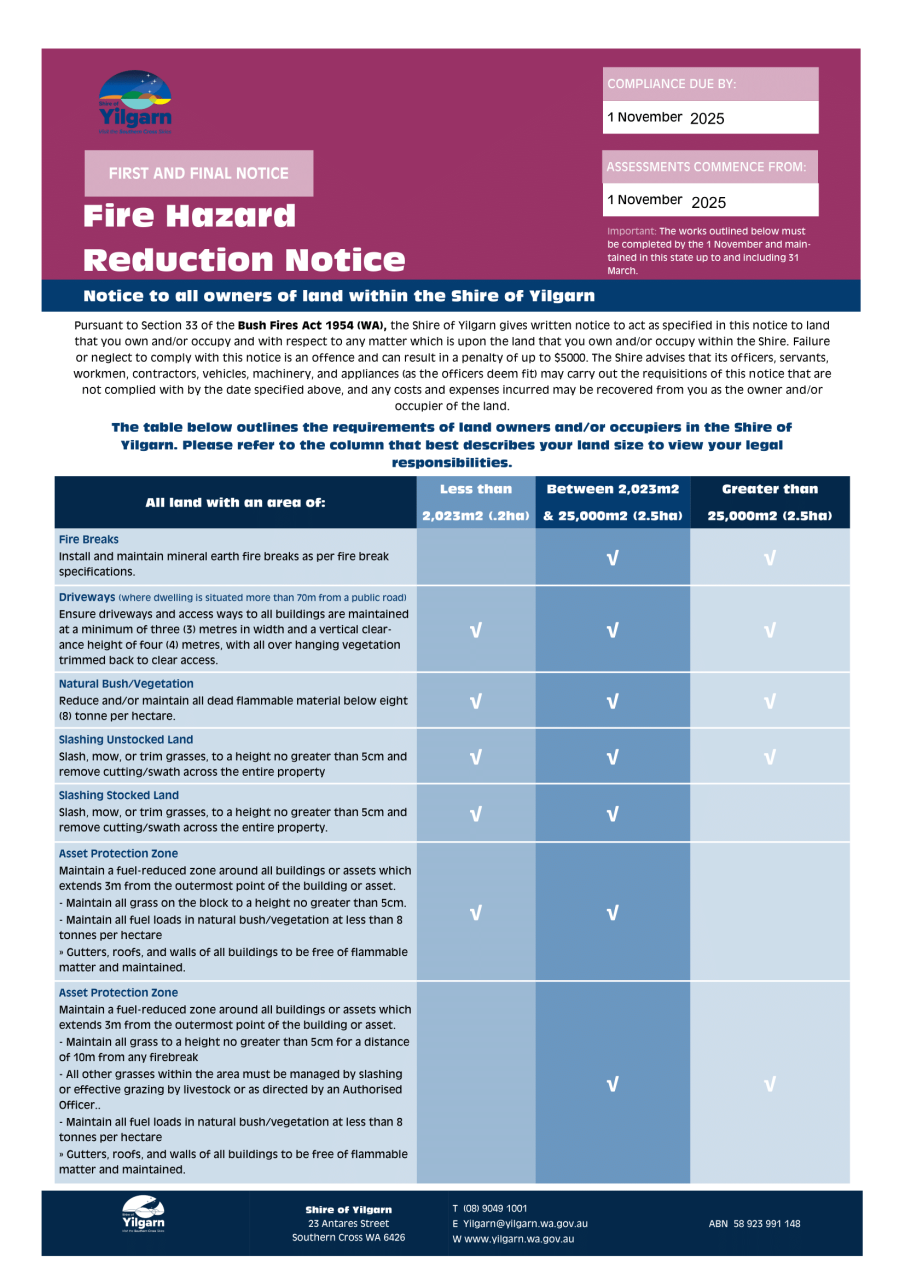
Fire Hazard Reduction Notice 2025
To make the notice larger, please click on each image below.
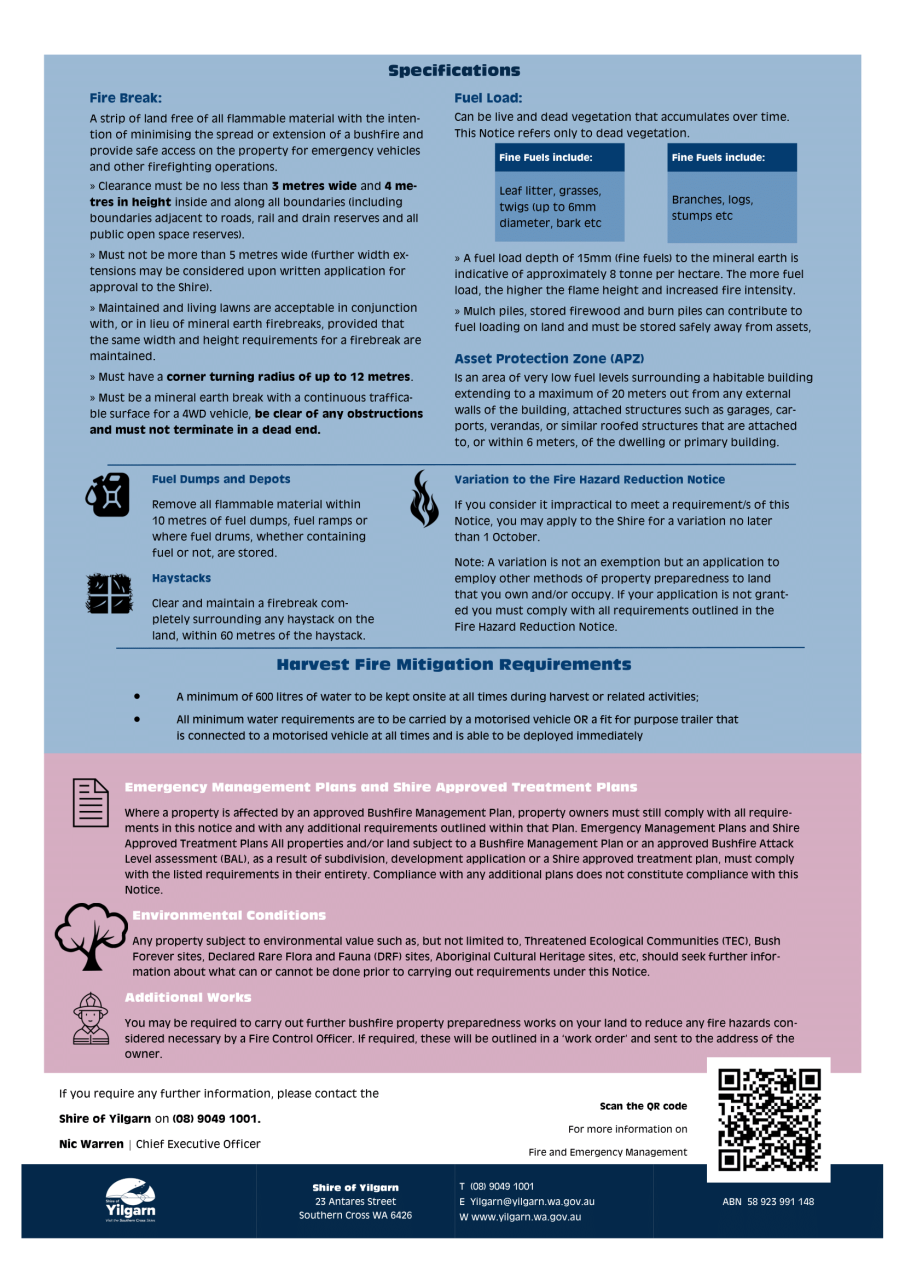
Burning Garden Refuse
The burning of garden refuse on the ground is NOT PERMITTED during the restricted and prohibited burning times, being from the 19th September through to 31st March, throughout the Yilgarn District.
Camp Fires
You can have a small camp fire for camping and cooking purposes during the restricted burning period, however you must ensure that the campfire is completely extinguished prior to leaving your camp site and please monitor the camp fire to ensure it is controlled while it is lit.
The lighting or use of fire in the open air for camping and cooking purposes is NOT PERMITTED during the prohibited burning period, being 1st November to 15th February, throughout the Yilgarn district.
Enclosed gas appliances are permitted, as long as they are used as per manufacturers instructions, and are used in a safe manner.
Harvest Bans
Information on Harvest Bans can be obtained by calling the Emergency Information Service Hotline on 08 9487 8777.
This service is updated daily during harvest months with information on harvest and vehicle movement bans, as well as on airport closures, fires, road closures and other emergency information.
We also encourage residents to register with the automated SMS and email notification service “Whispir” by signing up via the text sign up number found ON THIS PAGE or contacting the Shire.
Text from image:
Harvest and Vehicle Movement Bans
Operations Policy
Upon the implementation of a Harvest and Vehicle Movement Ban by the Shire of Yilgarn, the following applies:
1.1 The use or operation of any engine, vehicle, plant, equipment or machinery is prohibited within a paddock or lot, if the paddock or lot contains crop or pasture. This includes driving on roads/tracks that pass through such paddocks or lots;
1.2 The use or operation of any engine, vehicle, plant, equipment or machinery within 5 metres of a paddock or lot referred to in item 1.1 of this policy is prohibited;
1.3 Off-Road activity is prohibited.
Exemptions
- Vehicles carting water for stock is exempt, on the provision it is in the best interests of animal welfare, and a minimum of 600L remains in the vessel at all times and is able to be readily applied in the event of a fire;
- The use or operation of any engine, vehicle, plant, equipment or machinery within road reserves are exempt, on the provision the use is not likely to cause a fire;
Please note that the provisions for a declared Total Fire Ban take precedence over these exemptions.
Definitions
- Off-road Activity: Has the meaning applied under the Bush Fires Regulations 1954 and generally means the use or operation of any engine, vehicle, plant, equipment or machinery on land on which there is bush or which is under crop or pasture or stubble.
- Engine, vehicle, plant, equipment or machinery: means any engine, motor vehicle, plant, equipment or machinery that is, or that is activated by, an internal combustion engine.
- Crop: means a plant that is grown in large quantities, especially as food.
- Pasture: means land covered with grass or other vegetation that is suitable for feeding animals on.

Restricted and Prohibited Burning Times
The Gazetted Restricted and Prohibited Burning Times for each year are as follows:
| Restriction Type |
Restriction Period |
| Restricted burning period |
19 September to 31 October and 16 February to 31 March |
| Prohibited Burning Period |
1 November to 15 February |
Permits to burn during the Restricted Burning Period are required, and must be obtained from a Fire Control Officer.
For a list of the Fire Control Officers in your area, please click HERE and look under the Bush Fire Brigades section.
Permits to burn stubble from the previous seasons crop will not be issued until 1 March.
Burning is not permitted on any Sunday during the Restricted Burning Period.
Seasonal conditions
In accordance with Sections 17 and 18 of the Bush Fires Act 1954, Council may, if it considers that seasonal conditions warrant a variation of the prohibited or restricted burning times in its district, vary the prohibited or restricted burning times in respect of that year in the district or a part of the district by –
- shortening, extending, suspending or reimposing a period of prohibited or restricted burning times; or
- imposing a further period of prohibited or restricted burning times.
This variation cannot exceed more than 14 successive days.
In accordance with Sections 17 (10) and 18 (5) (c) of the Bush Fires Act 1954, Council delegates to the Shire President and the Chief Bush Fire Control Officer, jointly its powers and duties to vary Prohibited and Restricted Burning Times, in accordance with the Bush Fires Act 1954, as highlighted in this Policy.
Home Fire Safety – Be Prepared
House fires can occur without warning and spread rapidly. Every year, people are seriously injured or lose their lives in residential fires, often due to smoke inhalation and toxic fumes.
Most house fires are accidental and can be prevented through regular maintenance, safe practices, and emergency planning.
If a fire starts in your home, leave immediately and call Triple Zero (000). Do not attempt to fight a fire unless it is safe to do so and you have the appropriate equipment and training.
Remember: fire spreads quickly. A small flame can develop into a major fire in less than 30 seconds, and thick smoke can fill a home within minutes.
Plan Ahead
Taking simple precautions can significantly reduce the risk of a house fire and improve your family's ability to respond safely in an emergency.
The Shire of Yilgarn encourages residents to:
-
Install smoke alarms that comply with current Western Australian requirements.
-
Test smoke alarms regularly and replace batteries where required.
-
Develop and practise a home fire escape plan with all household members.
-
Identify at least two escape routes from every room where possible.
-
Teach children what to do if a smoke alarm sounds and not to hide during a fire.
-
Never leave cooking unattended.
-
Keep children away from matches, lighters, candles, and cooking appliances.
-
Never leave lit candles, cigarettes, or other ignition sources unattended.
-
Keep a fire blanket and fire extinguisher in the kitchen, positioned away from the cooking area and readily accessible.
-
Ensure fire extinguishers and fire blankets comply with Australian Standards and that household members understand how to use them safely.
-
Never use water to extinguish cooking oil or fat fires, as this can cause the fire to spread rapidly.
-
Install safety screens around open fireplaces and wood heaters.
-
Clean chimneys and flues regularly to prevent the build-up of soot and combustible materials.
-
Avoid overloading power boards and electrical outlets.
-
Keep electrical equipment clean and free from dust accumulation.
-
Use licensed and qualified tradespeople for electrical, heating, and gas installations.
Stay Safe During a Fire
If a fire occurs:
-
Leave the building immediately.
-
Call 000 as soon as it is safe to do so.
-
Alert other occupants and neighbours if necessary.
-
Stay low to the ground to avoid smoke and toxic fumes.
-
Before opening a door, carefully check whether it is hot. If it feels hot, use an alternative exit if available.
-
Never re-enter a burning building for any reason.
-
If you become trapped, close doors between yourself and the fire, seal gaps around doors if possible, and call 000 for assistance.
-
Follow instructions provided by emergency services operators.
If Clothing Catches Fire
Remember:
Stop – Drop – Cover – Roll
Pets During a Fire
If pets are trapped inside a burning building:
After a Fire
Even if a fire appears to have been extinguished, hidden dangers may remain.
After a fire:
-
Do not re-enter the property until emergency services have confirmed it is safe.
-
Be aware of structural damage, electrical hazards, and lingering smoke or toxic fumes.
-
Contact your insurance provider as soon as practical.
-
Photograph damage and document affected property and belongings.
-
Avoid disposing of damaged items until they have been recorded for insurance purposes.
-
Keep receipts for emergency accommodation, replacement items, clean-up costs, and other expenses that may be covered by insurance.
Recovery and Support
Recovering from a house fire can take time and may affect your physical, emotional, and financial wellbeing.
Seek assistance from family, friends, insurers, support services, and community organisations where needed. Early action can help make the recovery process smoother and reduce long-term impacts.
Preparing for a fire before it happens can save lives, reduce property damage, and help your household recover more quickly after an emergency.
DFES Resources available for download
Travelling During Bushfire Season
My Home Fire Safety Plan